The scroll inside a mezuzah is written by hand, letter by letter, by a trained scribe. It carries the words of the Shema — and it turns an ordinary doorframe into a reminder, every time you pass through it, of Whose home this really is.
Hand-written by a scribe, checked, and ready to hang — each one comes with a basic case included. Order as many as you have doorways, in either size.
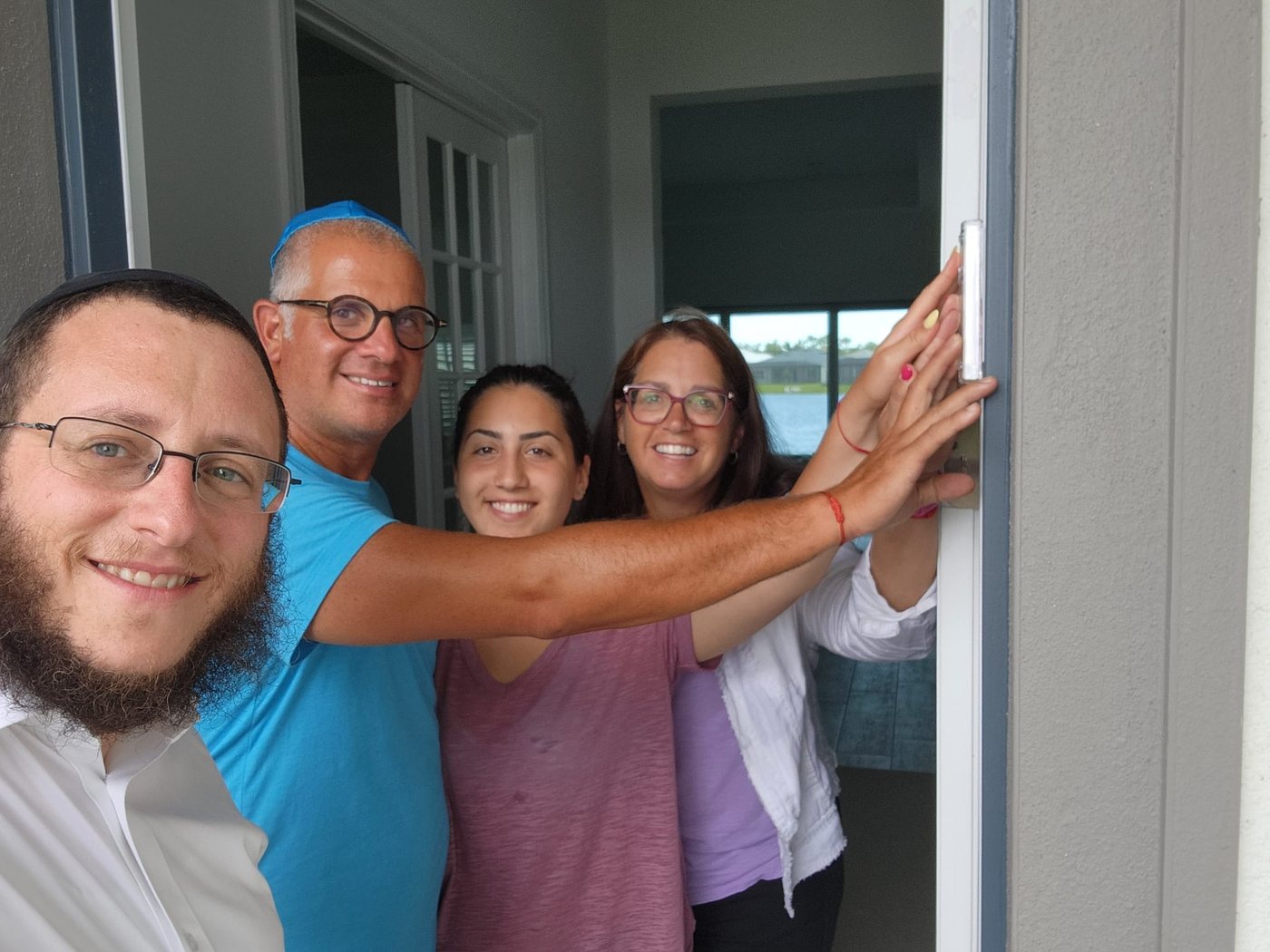
Tell us where you are and we'll come by, walk the house with you, work out which doorways need one, and affix them together — blessing and all.
Both, of course, is fine — order your scrolls and ask us to come and hang them.
The mitzvah is the parchment inside. A scribe writes it by hand with a quill, and a single cracked or missing letter makes the whole scroll unfit — which is why a real mezuzah can't be picked up at a gift shop or run off by a machine.
Two passages from the Torah, beginning with the Shema: “Hear O Israel, the L‑rd is our G‑d, the L‑rd is One.” The same passage ends with the line that put those words on your door in the first place — “and you shall write them on the doorposts of your house.”
On the outside of the rolled scroll is the Divine Name Sha‑dai, read by our sages as the initials of Shomer Daltot Yisrael — Guardian of the Doors of Israel. The Rebbe asked that every Jewish home have mezuzahs on all its doorways, as a protection for the family inside.
Four things decide the spot. Once you have seen it, you will never hang one wrong again.
Stand outside the doorway facing in. The mezuzah goes on the right-hand post — and for a bedroom or a kitchen that means the right side as you enter that room, not as you leave it.
Measure the height of the opening and take the upper third. The bottom of the mezuzah sits at or above the line where that top third begins.
Not squeezed up against the lintel — leave at least a handbreadth, roughly three or four inches, below the top of the doorway.
Ashkenazi custom, which we follow, sets the mezuzah at an angle, with its top leaning in toward the room it is protecting.
The whole thing at a real doorframe — the scroll, the case, the spot on the post, the angle, and the blessing. Watch it once and you will know exactly what to do at your own front door.
An archway with no lintel. A doorway you are not sure counts. A rented condo. Mezuzahs already hanging that may or may not still be kosher. None of that is in a video — so ask us. There is no question too small, and no charge for asking.
בָּרוּךְ אַתָּה ה' אֱלֹקֵינוּ מֶלֶךְ הָעוֹלָם אֲשֶׁר קִדְּשָׁנוּ בְּמִצְוֹתָיו וְצִוָּנוּ לִקְבּוֹעַ מְזוּזָה
Baruch atah Ado‑nai Elo‑heinu melech ha'olam, asher kideshanu b'mitzvosav v'tzivanu likboa mezuzah.
Blessed are You, L‑rd our G‑d, King of the universe, who has sanctified us with His commandments and commanded us to affix a mezuzah.
Every home has a doorway that isn't obvious — an archway, a laundry, a lanai slider, a room that is borderline in size. Don't guess: ask us, or have us come and walk the house with you. That is exactly what the visit is for.
Regular — $65. The size that fits most cases, and what to choose if you are starting fresh.
Small — $75. For a narrow case you already own that only takes a small scroll; the finer writing is what costs more.
Boxes everywhere, nothing where it belongs, and somewhere in the middle of it a bag of mezuzahs. Let us take that one off the list. Tell us where you are and what times suit, and someone from Chabad will come by, work out the doorways with you, say the blessing, and put them up.
No scrolls yet? Say so on the form and we will bring them along. Would rather just talk it through? Call (941) 493-2770.
Florida heat and humidity are hard on parchment. A mezuzah should be examined by a scribe twice every seven years, and any scroll that has been up a long while is worth a look. Bring yours in, or ask us when we visit, and we will have them checked for you.
